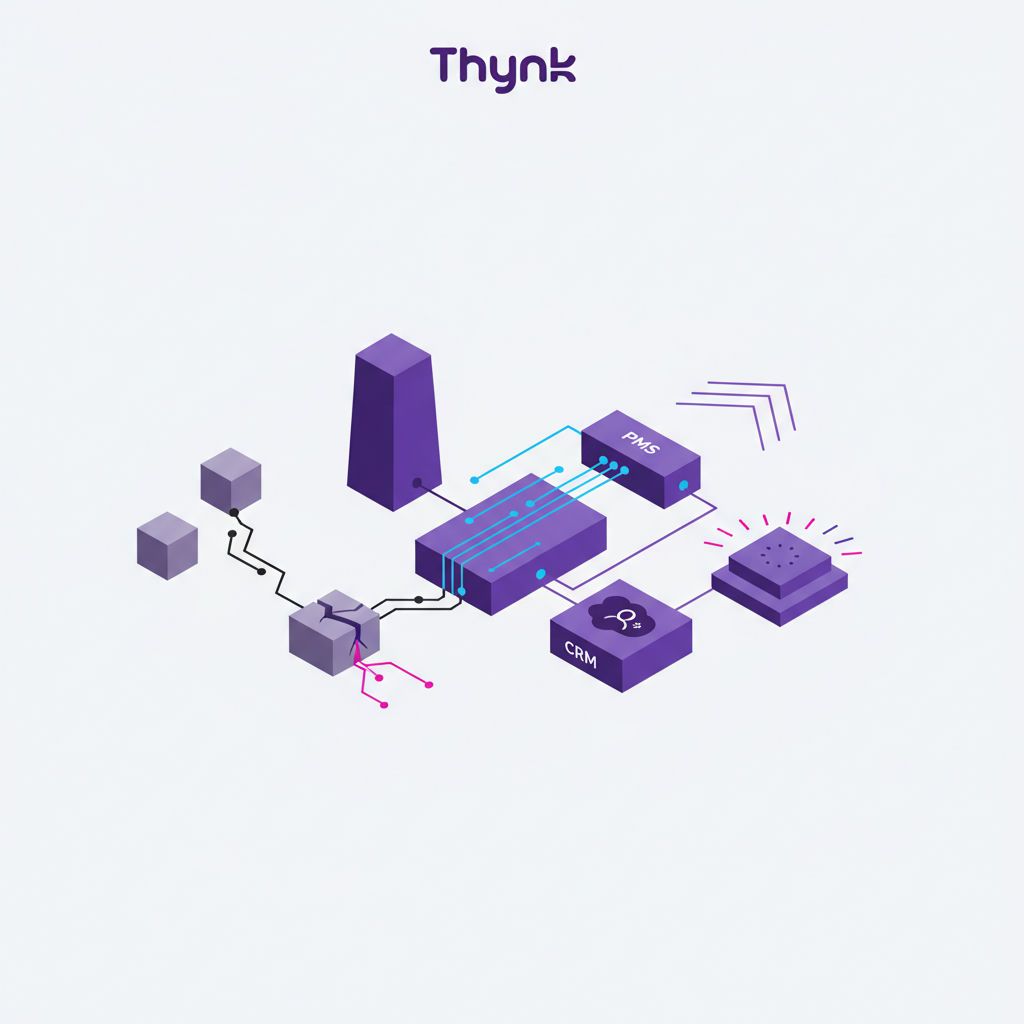
The High Cost of Disconnected Hotel Systems: Why Integration Matters for Revenue and Guest Experience
Disconnected systems cost European hotel operators between 286 and 470 hours annually—more than a month lost to inefficiency—while wasting 13-19% of operating costs through duplicate workflows, unreliable data, and missed upselling opportunities. Salesforce-native hospitality CRM platforms eliminate this fragmentation by unifying sales, operations, and revenue management in a single source of truth, delivering real-time PMS integration, unified channel management, and AI-powered sales automation that reclaim time and drive group conversion.
The Hidden Revenue Impact of System Fragmentation
Fragmentation doesn't just slow operations—it bleeds revenue. Research shows that 83% of operators struggle with stock control while 56% miss upselling opportunities due to disconnected inventory visibility. When sales, operations, and finance teams work from different systems, 50% can't trace where their data originates, delaying commercial decisions during critical booking windows.
This issue is particularly acute for MICE and group business. Without integrated room-block management and pickup tracking, properties lose visibility into group conversion and pace. 70% of operators confirmed that real-time consolidated data would improve decision-making speed—a capability that Salesforce-native hospitality CRM platforms deliver through unified sales pipelines and PMS parity.
The Cost of Data Distrust
60% of hospitality businesses report their data is incomplete or unreliable. When operators lack confidence in their systems, they default to manual verification—re-keying information, cross-checking spreadsheets, and duplicating effort. This "shadow work" compounds time loss and introduces human error that undermines commercial performance.
For operators managing multi-property portfolios or Global Sales Office (GSO) structures, this problem multiplies. Account hierarchy roll-up and centralized inventory require native integration—not middleware or batch syncs—to maintain accuracy across properties and segments. Without it, sales teams waste hours reconciling conflicting data instead of qualifying high-value accounts.
What Makes Integration Essential for Commercial Performance
Thynk's positioning as the Salesforce-native platform for hospitality addresses fragmentation at its core. By building on Salesforce rather than integrating with it, Thynk eliminates middleware, ensures Einstein Trust Layer governance for AI agents, and maintains PMS parity across its Sales/CRM and Group/MICE capability stack.
The PMS-First Integration Strategy
Industry guidance is clear: focus on your property management system (PMS)—the engine of the operation—then build outwards. This aligns with Thynk's architecture, which treats the PMS as the source of truth for finance and inventory while layering Group CRS, B2B CRM, and AI agents on top.
Key integration capabilities that eliminate fragmentation:
- Native PMS integrations: Real-time sync with Opera, Mews, Stayntouch, Protel ensures finance parity and inventory accuracy without middleware latency
- Channel hub connectivity: Multi-channel lead capture from Cvent RFP, GroupSync, marketplaces, and direct booking into a single Opportunity pipeline
- MCP (Model Context Protocol) for AI agents: Agentforce agents access unified data for RFP triage, qualification, and proposal drafting without system-switching
- Account hierarchy roll-up: Corporate, agency, and group accounts consolidate across properties for GSO visibility and sales velocity
- E-proposal and e-BEO generation: Automated proposal creation pulls real-time pricing, availability, and space allocation from unified inventory
This architecture reclaims the 286-470 hours lost to system-switching by eliminating manual data re-entry, duplicate reporting, and siloed workflows—time that sales teams can redeploy to qualifying high-value group accounts and accelerating conversion.
How AI Agents Amplify Hospitality CRM Performance
Research shows that 57% of consumers feel technology has improved their hospitality experience, and 45% believe AI could provide more accurate information or recommendations. However, 53% still prefer the human touch over fully automated service—a balance that well-architected hospitality CRM platforms strike by automating operational foundations while preserving human-led relationship development.
For operators, the biggest AI benefits are in forecasting, reporting, inventory control, and scheduling—operational foundations that directly impact guest experience. Thynk's integration of Agentforce and Einstein Trust Layer exemplifies this approach within its AI/Agents capability layer:
- AI email parsing: Automatically structures inbound RFPs into Salesforce Opportunities, eliminating manual data entry and accelerating response time
- RFP triage and qualification agents: Score and route leads based on fit, urgency, and revenue potential using historical conversion data
- Multi-property proposal generation: AI drafts e-proposals with room-block allocation, pricing, and BEO details across properties in minutes, not hours
- PACE/GRC reporting: Real-time analytics for group conversion, pickup, and ROI by source, account, and segment—without manual export/consolidation
This distinction matters for hospitality CRM alternatives comparison: platforms that require manual RFP parsing or lack governed AI access cannot deliver the same velocity gains without adding headcount. Salesforce-native architecture ensures AI agents work from clean, unified data protected by Einstein Trust Layer governance.
The Human Cost: Burnout and Operational Friction
Fragmentation doesn't just affect finances—it affects people. Operators in Switzerland, Germany, and Austria report the highest time losses (up to 470 hours annually), often in independent properties relying on legacy systems. The challenge is that hotels often don't have the time or headspace to invest in fixing this.
Integration isn't about adding more tech but simplifying the tech you already have. It's about freeing up your people. For sales teams, this means fewer hours wrestling with data exports and more time qualifying accounts, building relationships, and closing group business.
For revenue managers, it means faster access to PACE data and pickup trends without manual consolidation. For convention and exhibition operators, it means unified visibility across event bookings, exhibitor portals, and financial reporting—eliminating the "swivel-chair integration" that burns out staff.
How to Eliminate Hospitality CRM Fragmentation: Practical Steps
Industry guidance for operators mirrors Thynk's commercial strategy and applies whether operators are evaluating Salesforce-native alternatives or migrating from legacy systems:
Start with Integration, Not Features
Connect core systems (PMS, CRM, channel manager) before layering additional tools. A unified hospitality CRM built on Salesforce ensures that sales, operations, and finance work from the same real-time data—eliminating the 50% of operators who can't trace data origins. Focus on package management, space management, and room-block tracking as foundational capabilities.
Quick Wins First
Pilot AI for time-saving tasks like lead scoring, email parsing, or automated reporting. Thynk's AI-powered RFP triage agents demonstrate ROI within weeks by accelerating response time and improving qualification accuracy. These quick wins build organizational confidence for broader transformation.
Build Data Confidence
Establish a single source of truth (Salesforce-native CRM) to guide commercial decisions. This foundation is non-negotiable for multi-property groups, GSO structures, and operators managing complex group and MICE business. Clean data is the foundation of effective sales automation and AI agent performance.
Empower Teams with Training
Train staff on how technology simplifies workflows rather than adds complexity. The best hospitality CRM platforms reduce clicks, automate repetitive tasks, and surface actionable insights—but only if teams understand how to use them. Focus training on e-proposal workflows and pickup tracking to accelerate adoption.
Think Scalability
Choose platforms that evolve with multi-property growth, GSO expansion, and new distribution channels. Salesforce-native architecture ensures that as operators add properties, channels, or segments, the CRM scales without re-implementation or middleware proliferation. This applies equally to exhibition management and traditional hotel operations.
Preserve the Human Element
Use automation to create capacity for guest-facing work, not to replace personal service. The 53% of consumers who prefer human touch aren't rejecting technology—they're rejecting impersonal technology. Well-designed hospitality CRM frees staff to deliver the relationship-building that drives repeat bookings and account expansion.
The Path Forward: Integration, AI, and Revenue Performance
Industry research underscores what Thynk's platform demonstrates daily: integration is the unlock for hospitality revenue performance. When operators consolidate systems into a Salesforce-native hospitality CRM architecture, they reclaim 286-470 hours per year lost to system-switching and manual data entry.
They reduce operating costs by 13-19% through eliminated duplication and streamlined workflows. They restore data confidence for faster commercial decisions during critical booking windows. They enable AI agents to work from governed, unified data without security or compliance risk.
For convention centers, exhibition halls, and multi-property groups, this integration extends to exhibitor portals, e-BEO management, and GSO-level account roll-up—capabilities that fragmented systems simply cannot deliver without custom development or expensive middleware. The three pillars of modern hospitality CRM—Salesforce performance, clean data, and sales automation—require native architecture to function effectively.
The question isn't whether to integrate, but how quickly operators can move from fragmentation to a single, Salesforce-native hospitality CRM platform that treats PMS parity, sales automation, and AI governance as non-negotiable foundations.
Operators evaluating hospitality CRM alternatives should prioritize platforms that eliminate middleware, deliver real-time PMS sync, and provide governed AI access through Einstein Trust Layer—not systems that promise integration through batch syncs, APIs requiring custom development, or AI features without security governance.
Key Takeaways
- Modern hospitality CRM platforms eliminate the 286-470 hours yearly that European operators lose to disconnected systems, duplicate workflows, and manual data re-entry
- 60% report incomplete or unreliable data because fragmented systems prevent operators from establishing a single source of truth for commercial decisions
- 13-19% of operating costs are wasted on inefficiency when sales, operations, and finance teams work from disconnected platforms
- Integration starting with the PMS is the foundation—Salesforce-native hospitality CRM platforms eliminate middleware and ensure real-time financial and inventory accuracy
- AI agents work best with unified data: Agentforce and Einstein Trust Layer require governed, consolidated inputs to deliver RFP triage, qualification, and proposal generation
- 56% miss upselling opportunities due to poor inventory visibility—integrated channel hubs and PMS sync solve this by maintaining real-time room-block and pickup data
- Reclaiming time for guest-facing work is the ultimate ROI—automation should free people to build relationships and drive group conversion, not replace hospitality's human core
Related Resources: